10 Eco-Friendly House Design Ideas for Malaysian Homes
Most guides on eco-friendly house design stop at solar panels, rainwater tanks and energy-efficient appliances. But you spend around 90% of your time indoors, and the materials behind your walls, furniture and cabinets quietly shape the environment your family lives in every day.
Creating a more sustainable home is not only about reducing electricity consumption. It is also about choosing materials that are safer, making better use of natural ventilation and light, reducing waste, and investing in features that can last for years instead of needing frequent replacement.
For Malaysian homeowners, this approach is especially relevant. Our hot, humid climate means that cooling, ventilation, moisture resistance and material durability all play an important role in creating a comfortable and sustainable home.
So, what does an eco-friendly house design actually look like? Here are 10 practical ideas you can consider, starting from the inside out.
Key Takeaways
- Eco-friendly house design is more than solar panels, as it also includes healthier materials, natural ventilation, energy efficiency, water conservation, and durable interiors.
- Choose ultra-low formaldehyde boards and sustainable materials such as ENF, Super E0 and HVEA rubber wood for healthier, more responsible cabinetry choices.
- Invest in durable built-in cabinetry that lasts for years to reduce frequent replacements, renovation waste, and unnecessary material consumption.
- Use passive cooling and natural light through cross-ventilation, thoughtful window placement and shading to reduce reliance on air conditioning and artificial lighting.
- Improve energy and water efficiency with solar panels, battery storage, LED lighting, energy-efficient appliances, rainwater harvesting, and low-flow fixtures.
- A well-planned eco-friendly house design can offer long-term value by combining healthier materials, lower resource consumption, better comfort and reduced maintenance or replacement costs.
What Is Eco-Friendly House Design?

Eco-friendly house design refers to planning and building a home in a way that reduces its environmental impact while creating a healthier and more efficient living environment.
This can involve everything from the materials used for cabinets and furniture to how a home is positioned to capture natural light and airflow.
A truly sustainable approach considers the entire lifecycle of a home. Instead of simply asking, “Is this material environmentally friendly?”, homeowners can also consider questions such as:
- Will it last for many years?
- Is it safe for indoor use?
- Does it require frequent replacements?
- Can home reduce energy consumption naturally?
- Does the design make efficient use of available space?
- Can water and other resources be used more efficiently?
10 Eco-Friendly House Design Ideas That Start from the Inside Out
A. Choose Ultra-Low Formaldehyde Boards & Non-Toxic Finishes
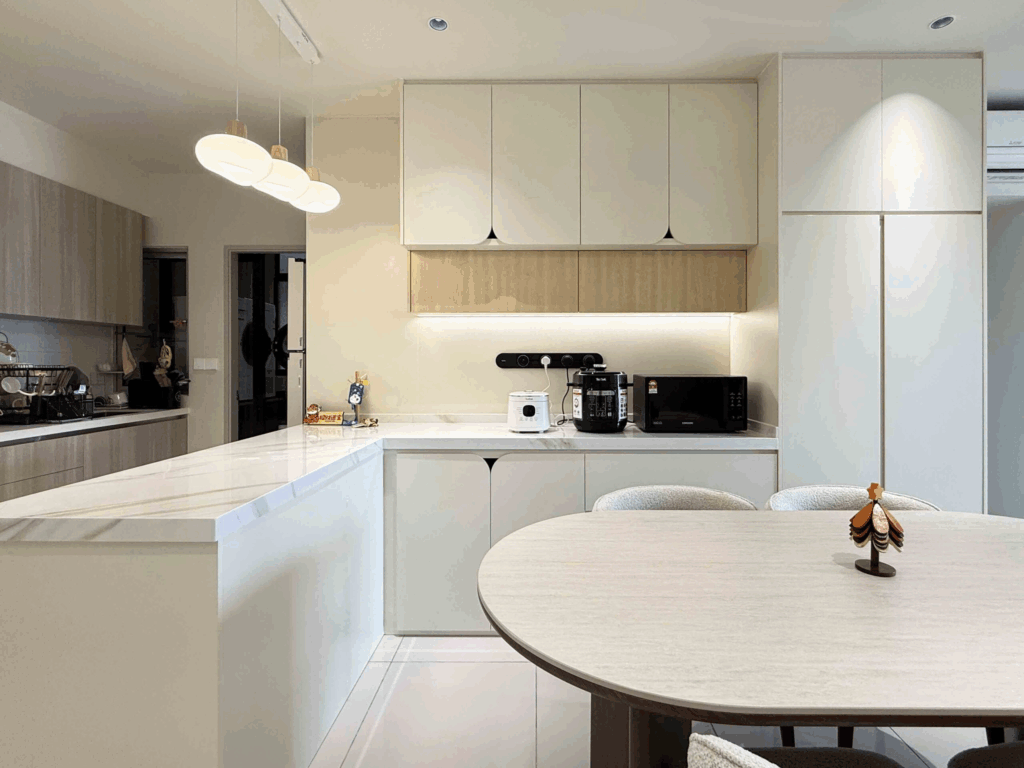
The materials inside your home matter because they contribute directly to your indoor environment. Cabinets, wardrobes, storage systems, and furniture can occupy a significant amount of space, so choosing lower-emission materials is an important consideration.
Look for boards with extremely low formaldehyde emissions, such as ENF or Super E0-rated boards, where applicable. These materials are designed to improve indoor air quality and reduce exposure to harmful emissions commonly found in conventional wood-based panels.
ENF boards:
- One of the lowest formaldehyde emission standards available (Japan F4 stars certified)
- Designed for superior indoor air quality and healthier living spaces
- Ideal for full-home cabinetry, wardrobes and built-in furniture
Super E0 boards:
- Very low formaldehyde emission level
- Commonly used eco-friendly board option in modern cabinetry
- Offers a good balance between safety, performance and cost
Pairing these boards with suitable low-VOC or non-toxic finishes can further support a healthier indoor environment.
Want to understand more about formaldehyde and board classifications? Read more about ENF Boards, Super E0 Boards, and Common Formaldehyde Myths and Facts.
B. Consider HVEA Rubber Wood
The type of timber used in your home can also be part of a more sustainable material strategy.
HVEA rubber wood is made from Malaysian rubberwood, giving homeowners another option when selecting materials for furniture and cabinetry. Beyond its material properties, using locally sourced timber can also support a more considered approach to material selection.
When choosing timber, look beyond appearance. Consider where it comes from, how it is processed, its durability, and whether it is suitable for the environment where it will be used.
Want to know more about HVEA rubber wood and its properties? Read the complete HVEA Rubber Wood Guide.
C. Build Cabinetry to Last Decades, Not Years

One of the simplest ways to make a home more sustainable is to avoid replacing things unnecessarily.
Cheap cabinetry may seem like the more environmentally friendly choice because it costs less upfront. However, if it needs to be replaced after only a few years, the additional materials, manufacturing and installation involved can add up.
Instead, consider investing in well-designed built-in cabinetry that is durable, functional, and suited to your home from the beginning.
A cabinet that continues serving your family for many years can reduce the need for repeated renovations and unnecessary material waste.
D. Use Passive Cooling & Cross-Ventilation
Malaysia’s tropical climate makes cooling a major consideration for homeowners.
Before relying entirely on-air conditioning, consider how your home can naturally encourage airflow. Cross-ventilation works by allowing air to enter through one opening and exit through another, creating a natural flow through space.
Consider the positioning of windows, doors, and openings when planning your renovation. Ceiling fans can also work alongside natural ventilation to improve comfort while using less energy than relying solely on-air conditioning.
E. Maximise Natural Light Without Excessive Heat Gain

Natural light can reduce the need for artificial lighting during the day, but too much direct sunlight can make indoor spaces uncomfortably hot.
The goal is to find a balance. Consider window positioning, curtains, blinds, external shading and other architectural features that allow daylight in while limiting excessive heat gain.
Light-coloured interiors and reflective surfaces can also help distribute daylight throughout a room, reducing the need to switch on lights unnecessarily.
F. Create Compact, Efficient Floor Plans
Bigger does not always mean better when it comes to sustainable homes.
An efficient floor plan can reduce the amount of material needed for construction and make the home easier to cool, light and maintain. Instead of adding storage everywhere, think about how existing spaces can perform multiple functions.
Built-in storage is particularly useful here. A well-planned cabinet can make use of awkward corners, vertical space and underutilised areas while keeping the home organised.
G. Add Rooftop Solar + Battery Storage

Solar panels are one of the most recognisable features of an eco-friendly home, and for good reason.
A rooftop solar system can allow a household to generate electricity from sunlight, potentially reducing dependence on electricity from the grid. Adding battery storage can provide another way to store energy generated during the day for use later.
However, solar should be considered as part of a bigger energy strategy. Improving insulation, ventilation, lighting, and appliance efficiency can help reduce the amount of energy your home needs in the first place.
H. Use Rainwater Harvesting & Low-Flow Fixtures
Water conservation is another important part of sustainable home design.
A rainwater harvesting system can collect rainwater for suitable non-potable uses, depending on the system and local requirements. Meanwhile, low-flow taps, showerheads, and dual-flush toilets can help reduce unnecessary water consumption.
These changes may seem small individually, but daily household water use adds over time.
I. Switch to Energy-Saving Lighting & Appliances

Lighting and appliances can have a noticeable impact on household electricity consumption.
Replacing inefficient bulbs with energy-saving LED lighting is a relatively simple upgrade. When purchasing appliances, look for models with strong energy-efficiency ratings and choose the right size for your household rather than automatically buying the largest option.
Smart controls, timers, and sensors can also help prevent lights and appliances from running when they are not needed.
J. Use Plants to Cool Your Home Naturally

Plants are not just for decoration. Strategically placed greenery can provide shade around windows and outdoor areas, while trees can help reduce the amount of direct heat reaching parts of your home. Plants can also make indoor and outdoor spaces feel more comfortable and connected to nature.
For Malaysian homes, consider tropical plants that are suited to the local climate and require manageable levels of maintenance.
The key is to use greenery strategically rather than simply filling every available space with plants.
Does Eco-Friendly House Design Cost More in Malaysia?
It can depend on the features and materials you choose. However, a higher upfront cost does not necessarily mean a higher overall cost in the long term.
For example, investing in more durable cabinetry may cost more initially but can reduce the need for replacement. Energy-efficient appliances and lighting may also cost more upfront while helping to reduce electricity consumption over time.
The same applies to solar systems, water-saving fixtures, and higher-quality materials.
Rather than focusing only on the initial renovation budget, consider the total value over the lifespan of your home. A useful question is not simply, “What is the cheapest option?” but “Which option gives me better value over the next 10, 20 or even 30 years?”
That long-term mindset is at the heart of a good eco-friendly house design.
Conclusion
A sustainable home does not have to look like a futuristic green building covered in solar panels.
Sometimes, it starts with much simpler decisions like choosing safer boards, selecting durable cabinetry, improving airflow, making better use of natural light, and reducing unnecessary energy and water consumption.
The best eco-friendly house design is one that works with the way your family actually lives. By combining thoughtful interior materials with passive design strategies and energy-efficient systems, you can create a home that is healthier, more comfortable, and more efficient for years to come.
Let ACE Cabinet Design Help You Create Your Eco-Friendly Home.

Building a more sustainable home starts with making better choices at every stage, including the cabinetry and materials you bring into your living spaces.
At ACE Cabinet Design, you can explore cabinetry solutions designed with durability, material quality and indoor air considerations in mind. From ultra-low formaldehyde boards to HVEA rubber wood options, choosing the right materials can be an important part of creating a healthier and longer-lasting home.
If you are planning a new home or renovation and want to explore more sustainable cabinetry options, speak to the team to find a solution that suits your space, lifestyle, and long-term needs.
For a more personalised experience, you are welcome to Contact ACE Cabinet Design today to schedule a free consultation or visit our showrooms.
🔗 Explore more of our designs and services at acecabinetdesign.com.my
FAQs
1. What is eco-friendly house design?
Eco-friendly house design focuses on creating a home that uses resources efficiently while reducing environmental impact. It can include sustainable materials, energy-efficient appliances, natural ventilation, water-saving fixtures, solar energy, and durable interior solutions.
2. How can I make my Malaysian home more eco-friendly?
Start with practical improvements such as using energy-efficient lighting and appliances, improving natural ventilation, maximising daylight, choosing durable and low-emission materials, reducing water consumption, and considering solar energy.
3. Are eco-friendly cabinets worth the investment?
They can be, especially when you consider durability, material quality, and long-term use. Cabinets that are designed to last longer can reduce the need for frequent replacement and renovation.
4. Is eco-friendly house design expensive?
Not necessarily. Some sustainable upgrades require a higher upfront investment, but others, such as LED lighting, better ventilation and efficient appliances, can be relatively simple. The key is to consider both the initial cost and long-term savings.
5. What materials should I look for when choosing eco-friendly cabinetry?
Consider materials with low formaldehyde emissions, durable construction and responsible material sourcing. ENF and Super E0 boards are options homeowners may wish to explore, while HVEA rubber wood is another material worth considering for cabinetry and furniture.